
Experimental Research (Section 42)
The Experimental Research organized section of the American Political Science Association advances pedagogy, research, and scholarly contributions based on randomized or natural experiments. Recent years have seen a dramatic increase in the number of published articles in political science that use experiments. Experimentalists are exploring topics that would have been unimaginable only a few years ago.
The rapid growth, development, and celebration of experimental methods in political science presents the opportunity to share a specific vocabulary and toolkit with researchers interested in experimental methods of all kinds. The section is devoted to helping scholars develop and hone these specialized skills and to providing a forum where research based in these techniques can be shared and discussed.
Founded: 2010
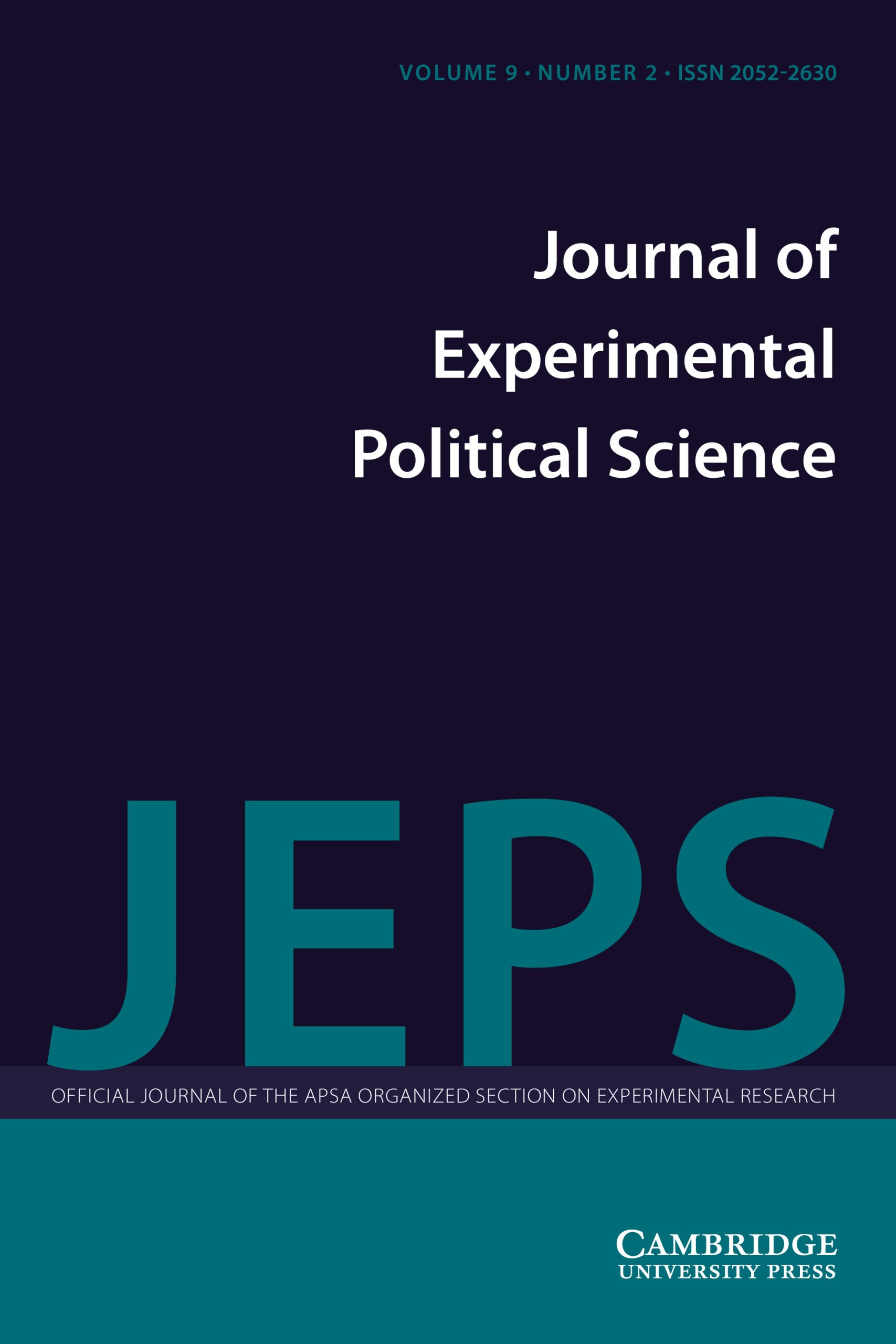
Journal: Journal of Experimental Political Science; published 3 times per year; discount for selecting online-only access.
Website: https://connect.apsanet.org/s42/
Social: @JEPS_ed (X) @experimentsapsa.bsky.social (Bluesky)
Newsletter: The Experimental Political Scientist
Section Membership Dues
| Student | Regular |
|---|---|
| $0 (Online Journal Only) | $24 (Online Journal Only) |
Section Journal
Section Officers
Section Officers
Section Awards
Section awards are presented during the APSA annual meeting awards ceremony. To learn more about any award listed, contact the award committee chair for the award.
All section 42. Experimental Research awards to-date »
Best Book Award
The Best Book Award recognizes the best book published in 2025 that either uses or is about experimental research methods in the study of politics. A copy of the book should be sent to each member of the selection committee at the addresses provided below. Deadline for nominations: April 15, 2026
Award Committee
| Name | Affiliation | |
|---|---|---|
| Will Nomikos | University of California, Santa Barbara | wnomikos@ucsb.edu |
| Ethan Busby | Brigham Young University | ethan.busby@byu.edu |
| Rebecca Weitz-Shapiro | Brown University | rebecca_weitz-shapiro@brown.edu |
Best Dissertation Award
The Best Dissertation Award recognizes the best dissertation completed in calendar year 2025 that utilizes experimental methods on substantive questions about politics or makes a fundamental contribution to experimental methods.
Nomination Instructions: Nominations should come from faculty members although they need not be on the student’s dissertation committee. Nominated dissertations should be emailed to all members of the selection committee at the addresses provided below.
Deadline for nominations: April 15, 2026
Award Committee
| Name | Affiliation | |
|---|---|---|
| Natán Skigin | University of Georgia | nskigin@uga.edu |
| Natalia Bueno | Emory University | natalia.bueno@emory.edu |
| Diane Bolet | University of Essex | diane.bolet@essex.ac.uk |
Best Paper Award
The Best Paper Award recognizes a paper that was scheduled to be presented at APSA in 2025 and features experimental research.
Nomination Instructions: Chairs of and discussants on panels are especially encouraged to nominate papers, although anyone who is aware of an interesting paper prepared for presentation can make the nomination. Self-nominations are welcome. Nominated papers should be emailed to all members of the selection committee at the addresses provided below.
Deadline for nominations: April 15, 2026
Award Committee
| Name | Affiliation | |
|---|---|---|
| Sumitra Badrinathan | American University | sumitrab@american.edu |
| Chagai Weiss | University of Toronto | chagai.weiss@utoronto.ca |
| Talbot Andrews | Cornell University | talbot.andrews@cornell.edu |
Public Service Award
Many experiments only occur thanks to the assistance of non-researchers who provide access to resources and data. This award recognizes a special form of public service, the facilitation of randomized experiments in political science by those outside the academy. Considerations in the evaluation of nominees for this award include (1) their generosity with time, resources, and data and (2) their willingness to permit research transparency (e.g., allowing researchers to publish research without regard to how the results come out).
Nomination Instructions: Researchers should send a one paragraph description of the nominee to all committee members.
Deadline for nominations: April 15, 2026
Award Committee
| Name | Affiliation | |
|---|---|---|
| Jake Bowers | University of Illinois | jwbowers@illinois.edu |
| Guy Grossman | University of Pennsylvania | ggros@sas.upenn.edu |
| Kathleen Searles | University of South Carolina | k_searles@sc.edu |
Best Replication in JEPS 2025
The Best Replication in JEPS Award recognizes the best replication in JEPS in the prior year. Deadline for nominations: April 15, 2026
Award Committee
| Name | Affiliation | |
|---|---|---|
| Jenn Jerit | Dartmouth College | Jennifer.L.Jerit@dartmouth.edu |
| Scott Clifford | Texas A&M University | scottaclifford@gmail.com |
| Bert Bakker | University of Amsterdam | B.N.Bakker@uva.nl |
Best Paper Based on a Pre-Analysis Plan in JEPS
The Best Paper based on a pre-analysis plan in JEPS in the prior year Deadline for nominations: April 15, 2026
Award Committee
| Name | Affiliation | |
|---|---|---|
| Jenn Jerit | Dartmouth College | Jennifer.L.Jerit@dartmouth.edu |
| Scott Clifford | Texas A&M University | scottaclifford@gmail.com |
| Bert Bakker | University of Amsterdam | B.N.Bakker@uva.nl |
Rebecca Morton Award for Best JEPS Article in 2025
The Rebecca Morton Award for Best JEPS Article Award recognizes the best article in JEPS in the prior year. Deadline for nominations: April 15, 2026
Award Committee
| Name | Affiliation | |
|---|---|---|
| Jenn Jerit | Dartmouth College | Jennifer.L.Jerit@dartmouth.edu |
| Scott Clifford | Texas A&M University | scottaclifford@gmail.com |
| Bert Bakker | University of Amsterdam | B.N.Bakker@uva.nl |