
2026 APSA Dissertation Workshops
2026 APSA Virtual Dissertation Workshop Applications Now Open!
2026 APSA Dissertation Workshops | Deadline: April 26, 2026
APSA sponsors in-person & virtual dissertation workshops annually. Our in-person events are held the Wednesday prior to the APSA Annual Meeting. Each full-day workshop includes six PhD candidates who present a dissertation chapter, along with two faculty members who lead the workshop and moderate discussions. Submit your proposals now!
Each virtual workshop includes six PhD candidates who present a dissertation chapter, along with two faculty members who lead the workshop and moderate discussions. Virtual workshops are held over a two-week period during the summer.
View Workshop Descriptions and Criteria below:
2026 Workshop Descriptions and Criteria
Public Administration and Policy
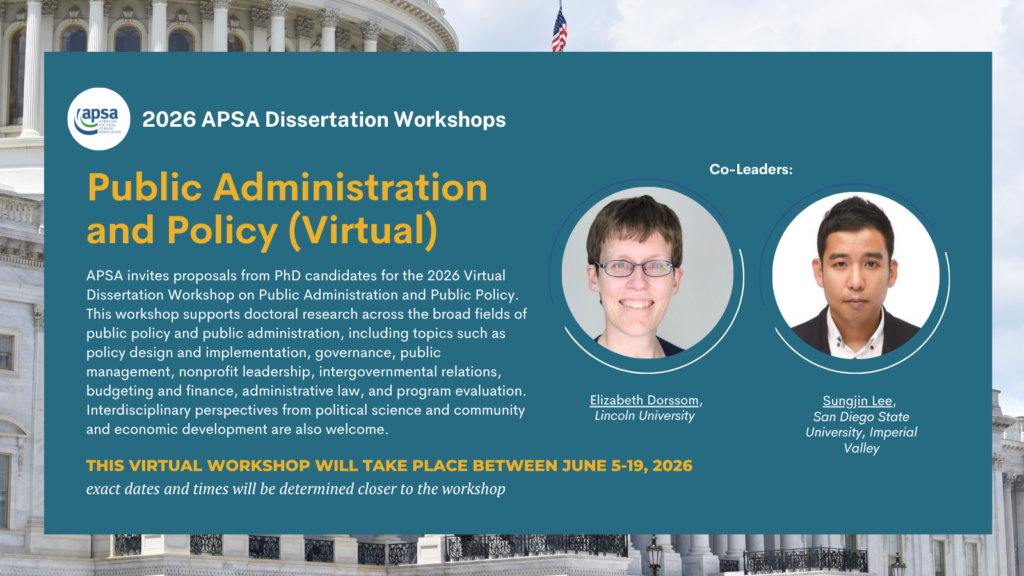
This virtual dissertation workshop will provide both faculty and peer feedback to doctoral candidates pursuing degrees in public policy and/or public administration. This workshop is designed to support participants in strengthening their methodology, structure, theoretical framing, writing, and overall research direction.
Projects may span the breadth of these fields, including but not limited to policy design and implementation, governance, public management, nonprofit leadership, intergovernmental relations, budgeting and finance, administrative law, and program evaluation. In addition to expertise in public policy and public administration, participants will benefit from interdisciplinary perspectives in political science and community and economic development, allowing for broader theoretical, institutional, and applied feedback.
Co-Leaders:
- Elizabeth Dorssom, Lincoln University
- Sungjin Lee, San Diego State University, Imperial Valley
Virtual: June 5-19, 2026 | Submit Proposals Here
(exact dates and times will be determined closer to the workshop) – this workshop is free!
The workshop itself will consist of 3 structured sessions:
- Session 1: The first session will serve as an introduction, where faculty outline key themes and expectations, and candidates provide context for their work. During this session, participants will be grouped by methodological approach and paired with a faculty co-lead to facilitate more targeted, small-group engagement.
- Session 2: The second session will function as a collaborative writing workshop that includes fellow candidates. Participants will be grouped based on topic or approach, with an emphasis on workshopping writing styles, organization, and argumentation in light of the feedback received.
- Session 3: The third session will bring participants back together with the faculty co-leads, where each candidate will present their work and engage in a structured discussion designed to generate constructive, actionable feedback for revision.
Our overarching objective is to foster a supportive scholarly community while helping participants make meaningful progress on their dissertations through detailed, actionable feedback and guided peer engagement.
**DEADLINE: April 26, 2026
Participants will be notified by early May 2026.
Questions may be directed to teaching@apsanet.org
New Topics in European Politics
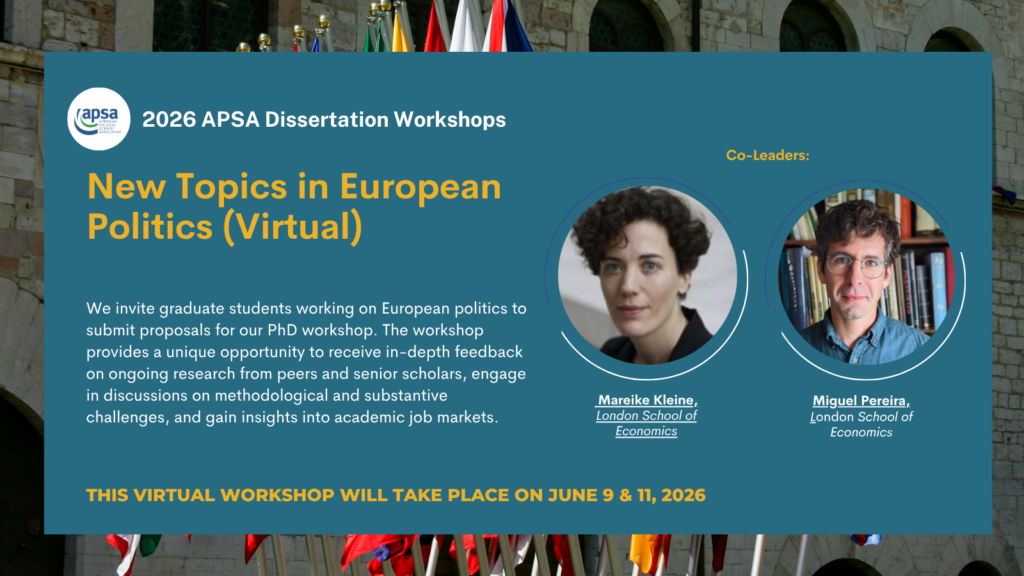
We invite graduate students working on European politics to submit proposals for our PhD workshop. The workshop provides a unique opportunity to receive in-depth feedback on ongoing research from peers and senior scholars, engage in discussions on methodological and substantive challenges, and gain insights into academic job markets.
Co-Leaders:
- Mareike Kleine, London School of Economics
- Miguel Pereira, London School of Economics
Virtual: June 9 and June 11, 2026 | Submit Proposals Here
This workshop is open to all methodological approaches and research areas within European politics. While the expertise of the workshop leaders—Mareike Kleine (EU politics, international political economy, and international organizations) and Miguel Pereira (political behavior, elite politics, and comparative politics)—covers a broad spectrum, we welcome submissions on any relevant topic.
The workshop will feature sessions dedicated to presentations and feedback as well as individual consultations with one or both workshop leaders on dissertation and/or European job markets.
**DEADLINE: April 26, 2026
Participants will be notified by early May 2026.
Questions may be directed to teaching@apsanet.org
Migration & Citizenship
Co-Leaders:
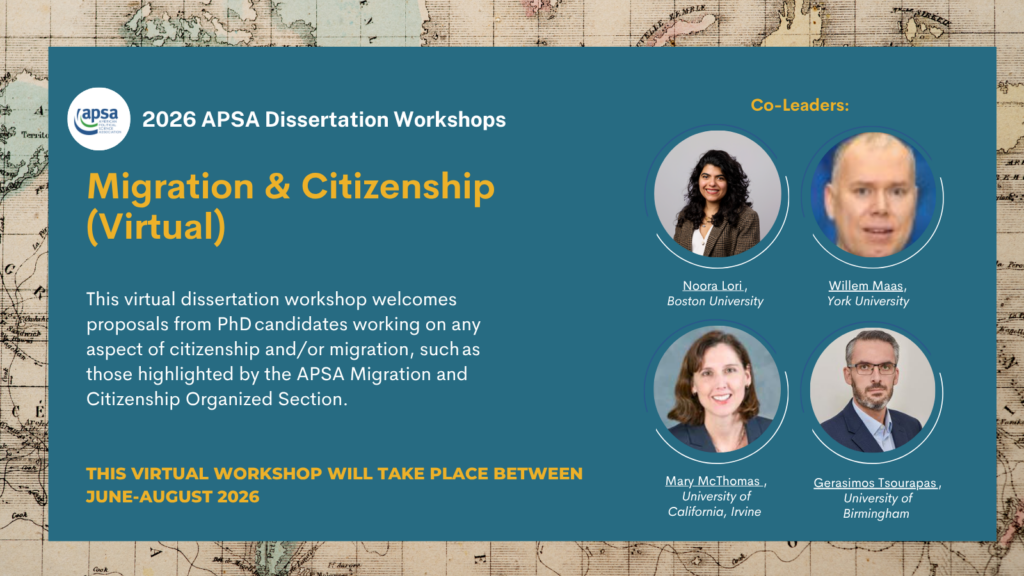
- Noora Lori , Boston University
- Willem Maas, York University
- Mary McThomas , University of California, Irvine
Virtual: (TBD: exact dates and times will be determined once participants are selected)
Note: Two virtual workshops will be held with 6-8 graduate students each, led by 2 co-leaders. Co-leader and participants will be grouped to align topics.
This virtual dissertation workshop welcomes proposals from PhD candidates working on any aspect of citizenship and/or migration, such as those highlighted by the APSA Migration and Citizenship Organized Section:
- The local, national, transnational, international, and global politics of voluntary and forced migration, including political attitudes and orientations both towards and of all categories of migrants, including refugees and asylum seekers, internally displaced persons, and economic, family, circular, business, high-skilled, and irregular migrants.
- Immigration and emigration policies and laws, including the international relations, international political economy, and political philosophy aspects of such policies and laws.
- Immigrant integration and refugee resettlement policies and their implementation, including immigrant and refugee civic engagement, political incorporation, and citizen-making.
- Border and security studies as well as studies on intranational, regional, transnational, and international cooperation on the management and control of migration.
- The changing meanings and practices of citizenship, including the relationship between citizenship and identity, gender, multiculturalism, race and ethnicity, racism and xenophobia, human rights, indigenous peoples, empires and imperialism, civic engagement, transnationality, welfare, and public policy.
- The relationship between citizenship and transformations in or political contestation of sovereignty and political community, including state formation or disintegration, nationalism, sovereignty or secession movements, language, ethnic or other minorities, the politics of diaspora mobilization (including conflicts, democratization, voting, and economic development), and subnational, supranational (e.g., European Union), multilevel, corporate, or global citizenship.
- The politics of nationality and citizenship (and the distinctions between them), including the moral and empirical rights and obligations attached to citizenship, comparative or historical nationality law, statelessness, and policies and practices concerning the acquisition and loss of nationality through such procedures as naturalization and expatriation as well as dual or multiple citizenship.
By the end of the workshop, students will leave with concrete revisions to strengthen their dissertations and future research, as well as an expanded network of scholars working in similar areas.
**DEADLINE: April 26, 2026
Participants will be notified by early May 2026.
Questions may be directed to teaching@apsanet.org
Previous Workshops
2025 APSA Dissertation Workshops
Policy and Public Administration (Virtual)
Join us for a virtual dissertation workshop on “Policy and Public Administration.” This dissertation workshop cohort will meet virtually June 2nd through June 13th, 2025, with exact meeting times TBD.
Co-Leaders:
- Darrell Lovell, West Texas A&M University
- Scott Langford, Arizona State University
This virtual dissertation workshop focuses on providing feedback to doctoral candidates pursuing their doctorate in public administration and policy or with dissertations on topics in public policy. The topics can span the breadth of the fields in both public administration and policy. Potential topics include public management, organizational theory, political economy, policy theory (i.e., punctuated equilibrium, policy diffusion, advocacy theory, multiple streams theory), and policy areas such as but not limited to education, higher education, housing, immigration, and environmental/energy policy. Dissertations using both qualitative and quantitative methods or a mixed-methods approach are welcome.
The goal of this workshop is to offer doctoral candidates at various stages an opportunity to engage faculty and peers on their work. The workshop setting will allow for collegial engagement among all involved and is designed to assist with methodology, structure, theory, writing, and/or research direction. Before the workshop, candidates will submit a chapter of their dissertation for review by all candidates and faculty two weeks ahead of time. During the workshop, the candidates will participate in three sessions. The first session will be an introductory session with the faculty to introduce topics and concepts and set the stage for where the candidates are in the process. Each candidate will be expected to preface their submission and provide context. In the first session, the students will be grouped with a faculty co-lead by methodology to get help within a small group. The second session will be inclusive of fellow candidates. This will be a writing workshop, where each candidate will be put into one of two groups based on topics or approach. The goal of the second session is to workshop writing styles and approaches based on the feedback provided. The third session will be with the faculty co-leads and allow for each student to present their work and field questions that contribute to a constructive edit of their work. We will use Zoom for holding the sessions and candidates will be expected to be prepared to engage in all parts of the process.
Comparative and Multi-Method Approaches within Political Economy Research
Join us for an in-person dissertation workshop held during the 2025 APSA Annual Meeting on Wednesday, September 10, 2025, in Vancouver, BC, Canada.
Co-Leaders:
- Javier Pérez Sandoval, University of Oxford and University of Notre Dame
- Elizabeth G. Pfeffer, Dartmouth College
Workshop Description
Comparative scholars increasingly draw upon a variety of methods to investigate key questions raised by political economies across the global community. This “triangulation” of approaches often leads to substantially richer and more nuanced accounts of variation across and within countries on key matters of democratic policy and politics.
In this workshop, the co-leaders will support early career researchers in considering the utility and sharpening the application of mixed methods approaches to key political economy questions including, but not limited to, such topics as redistribution, democratization, economic policy, unionization, and social policy.
The workshop is open to participants who utilize two or more methodologies of any nature within their thesis. Although individual chapters proposed for the workshop may utilize one method exclusively, participants should be prepared to contextualize the piece within their broader dissertation. We welcome research focused on any substantive area within political economy (broadly construed) and any regional, country, or subnational geographic focus.
New Topics in European Politics (Virtual)
Join us for a virtual dissertation workshop held June 4- 24 (exact dates and times will be determined once participants are selected).
Co-Leaders:
- Mareike Kleine, London School of Economics
- Miguel Pereira, London School of Economics
Workshop Description
We invite graduate students working on Europe to submit proposals for our PhD workshop. The workshop provides a unique opportunity to receive in-depth feedback on ongoing research from peers and senior scholars, engage in discussions on methodological and substantive challenges, and gain insights into academic job markets. The workshop is open to all methodological approaches and research areas within Europe and European politics.
While the expertise of the workshop leaders—Mareike Kleine (EU politics, international political economy, and international organizations) and Miguel Pereira (political behavior, elite politics, and comparative politics)—covers a broad spectrum, we welcome submissions on any relevant topic.
The workshop will feature two sessions dedicated to presentations and feedback, individual consultations with one or both workshop leaders, and a 1-hour Q&A session on European job markets.
We encourage proposals from students at various stages of their research.
Migration and Citizenship (Virtual)
Join us for a virtual dissertation workshop held from the end of June through the middle of August (exact dates and times will be determined once participants are selected).
Co-Leaders:
- Irene Bloemraad, University of British Columbia
- Willem Maas, York University
Workshop Description
This virtual dissertation workshop welcomes proposals from PhD candidates working on any aspect of citizenship and/or migration, such as those highlighted by the APSA Migration and Citizenship Organized Section:
- The local, national, transnational, international, and global politics of voluntary and forced migration, including political attitudes and orientations both towards and of all categories of migrants, including refugees and asylum seekers, internally displaced persons, and economic, family, circular, business, high-skilled, and irregular migrants.
- Immigration and emigration policies and laws, including the international relations, international political economy, and political philosophy aspects of such policies and laws.
- Immigrant integration and refugee resettlement policies and their implementation, including immigrant and refugee civic engagement, political incorporation, and citizen-making.
- Border and security studies as well as studies on intranational, regional, transnational, and international cooperation on the management and control of migration.
- The changing meanings and practices of citizenship, including the relationship between citizenship and identity, gender, multiculturalism, race and ethnicity, racism and xenophobia, human rights, indigenous peoples, empires and imperialism, civic engagement, transnationality, welfare, and public policy.
- The relationship between citizenship and transformations in or political contestation of sovereignty and political community, including state formation or disintegration, nationalism, sovereignty or secession movements, language, ethnic or other minorities, the politics of diaspora mobilization (including conflicts, democratization, voting, and economic development), and subnational, supranational (e.g., European Union), multilevel, corporate, or global citizenship.
- The politics of nationality and citizenship (and the distinctions between them), including the moral and empirical rights and obligations attached to citizenship, comparative or historical nationality law, statelessness, and policies and practices concerning the acquisition and loss of nationality through such procedures as naturalization and expatriation as well as dual or multiple citizenship.
By the end of the workshop, students will leave with concrete revisions to strengthen their dissertations and future research, as well as an expanded network of scholars working in similar areas.
Fieldwork Approaches in Comparative Politics: MENA Region (Virtual)
Join us for a virtual dissertation workshop held in October 2025 (exact dates and times will be determined once participants are selected).
Co-Leaders:
- Ozlem Tuncel, Georgia State University
- Ronay Bakan, Johns Hopkins University
Workshop Description
We invite dissertation projects that employ fieldwork methodologies to explore a wide range of political issues in the MENA region. This workshop will be held virtually and is designed for advanced ABD students who have defended their dissertation prospectus and are conducting research in comparative politics with a fieldwork-based approach in the MENA region.
Participants will submit a single dissertation chapter—preferably one focused on analysis—for structured feedback and discussion. The workshop will provide an opportunity for participants to present a brief overview of their broader project to foster intellectual exchange in a collaborative mini-conference setting.
We specifically welcome diverse methodological orientations in conducting fieldwork and innovative methods that challenges traditional knowledge production on/in the Middle East and North Africa. Submissions may address, but are not limited to, the following topics:
• State-society relations and authoritarian governance
• Conflict, post-conflict reconstruction, and transitional justice
• Contentious politics, protest movements, and revolutions
• Political parties, elections, and democratization
• Urban and local politics
• Identity politics, sectarianism, and nationalism
• Refugees, migration, and diaspora politics
• Gender and politics, including feminist and queer perspectives
• Informal institutions, clientelism, and patronage networks
• Comparative political economy of the MENA region
• The role of religion in politics and governance
• Foreign interventions, humanitarianism, and peacebuilding
• Surveillance, digital repression, and the politics of technology
The workshop will be organized into two key sections:
1. Targeted Chapter Feedback – Participants will receive in-depth comments on their submitted chapters from peers and faculty facilitators, fostering constructive discussions about theoretical, methodological, and empirical contributions.
2. Advancing the Dissertation & Professional Development – The second half of the workshop will focus on strategies for completing the dissertation, positioning research for the academic job market, and advancing projects while on the tenure track.
In addition to individual guidance, the workshop will serve as a space for broader discussions on emerging research trends, methodological challenges, and the state of the literature in comparative politics and MENA studies. A key goal of this workshop is to cultivate an intellectual community where participants engage in peer review, receive constructive critiques, and develop lasting professional relationships.
By the end of the workshop, students will leave with concrete revisions to strengthen their dissertations and future research, as well as an expanded network of scholars working in similar areas. We look forward to fostering a dynamic and supportive environment for advancing fieldwork-based scholarship in comparative politics.
2024 APSA Dissertation Workshops
Black Politics in the United States
Co-Leaders:
- Dr. Periloux Peay, University of Maryland, College Park
- Dr. Jenn Jackson, Syracuse University
Workshop Description: Many scholars of black politics find themselves at a troubling crossroads. There is currently a concerted effort at the local, state, and federal levels of government to undermine, discredit, and discourage those tasked with teaching and studying black politics. This reality is almost certainly impacting the development of graduate students interested in illuminating and explaining the conditions many black Americans face in the United States and beyond.
We seek to combat ideologically extreme and racist ideas that threaten our collective knowledge by providing space to develop and engage with emerging scholars whose dissertations explore black politics in America. This workshop will be held in person on Wednesday, August 30th, at the 2023 annual meeting in Los Angeles, CA. The ideal candidates will be ABD students who have defended their dissertation prospectus in a topic focused on black politics. Candidates will be asked to submit a single chapter from their dissertation project for feedback and discussion. They will also have an opportunity to provide a brief presentation of the broader project to begin the conversation with colleagues at the mini-conference.
We invite submissions in the following, but not exhaustive, topical areas of black politics situated across the full spectrum of theoretical and methodological orientations:
- Critical studies rooted in blackness/anti-blackness
- Black political behavior
- Black representation
- Black-led social movements
- Black political psychology
- Intersectionality
- LGBTQ+ identity and black politics
- Black rural politics
- Policies that disproportionately impact black communities
- Black incarceration
This in-person workshop will be organized into two parts. The first section will be devoted to providing targeted feedback and facilitating robust conversations around chapters submitted by the individual students. The second section will focus on developing strategies for completing the dissertation, positioning the work on the academic job market, and advancing the dissertation project while on the tenure track.
Through this process, we will provide individual students with guidance and create a space for a broader discussion about the state of the literature and avenues for new research. The workshop will require participants to engage in peer review and will be a collaborative space. Students will leave the workshop with directed revisions to strengthen both their theoretical and methodological approaches to dissertations and future studies. Finally, this workshop will create a stronger relationship with their peers and others that they are in intellectual conversation with. We intend for students to use this opportunity to build their scholarly network, engage with peers and faculty with shared interests and experiences, and commune with one another – “relax. relate. release.”
Migration and Citizenship
.png?ver=c5lICTQkKZMBLq6Yu4Invg%3d%3d "Educate Blog Templates (1)")
Co-Leaders:
- Dr. Margaret Peters, University of California Los Angeles
- Dr. Juliette Tolay, Pennsylvania State University at Harrisburg
Workshop Description: This in-person dissertation workshop welcomes proposals from PhD candidates working on any aspect of citizenship and/or migration, such as those highlighted by the APSA Migration and Citizenship Organized Section:
- The local, national, transnational, international, and global politics of voluntary and forced migration, including political attitudes and orientations both towards and of all categories of migrants, including refugees and asylum seekers, internally displaced persons, and economic, family, circular, business, high-skilled, and irregular migrants.
- Immigration and emigration policies and laws, including the international relations, international political economy, and political philosophy aspects of such policies and laws.
- Immigrant integration and refugee resettlement policies and their implementation, including immigrant and refugee civic engagement, political incorporation, and citizen-making.
- Border and security studies as well as studies on intranational, regional, transnational, and international cooperation on the management and control of migration.
- The changing meanings and practices of citizenship, including the relationship between citizenship and identity, gender, multiculturalism, race and ethnicity, racism and xenophobia, human rights, indigenous peoples, empires and imperialism, civic engagement, transnationality, welfare, and public policy.
- The relationship between citizenship and transformations in or political contestation of sovereignty and political community, including state formation or disintegration, nationalism, sovereignty or secession movements, language, ethnic or other minorities, the politics of diaspora mobilization (including conflicts, democratization, voting, and economic development), and subnational, supranational (e.g., European Union), multilevel, corporate, or global citizenship.
- The politics of nationality and citizenship (and the distinctions between them), including the moral and empirical rights and obligations attached to citizenship, comparative or historical nationality law, statelessness, and policies and practices concerning the acquisition and loss of nationality through such procedures as naturalization and expatriation as well as dual or multiple citizenship.
Comparative & Multi-Method Approaches within Political Economy Research
.png?ver=6JZUfqJUiceoj19c2-ZUMw%3d%3d "Educate Blog Templates (2)")
Co-Leaders:
- Dr. Javier Pérez Sandoval, University of Oxford
- Dr. Elizabeth G. Pfeffer, Dartmouth College
Workshop Description: Comparative scholars increasingly draw upon a variety of methods to investigate key questions raised by political economies across the global community. This “triangulation” of approaches often leads to substantially richer and more nuanced accounts of variation across and within countries on key matters of democratic policy and politics. In this workshop, the co-leaders will support early career researchers in considering the utility and sharpening the application of mixed methods approaches to key political economy questions including, but not limited to, such topics as redistribution, democratization, economic policy, unionization, and social policy. The workshop is open to participants who utilize two or more methodologies of any nature within their thesis. Although individual chapters proposed for the workshop may utilize one method exclusively, participants should be prepared to contextualize the piece within their broader dissertation. We welcome research focused on any substantive area within political economy (broadly construed) and any regional, country, or subnational geographic focus.
2023 APSA Dissertation Workshops
Black Politics in the United States
Co-Leaders:
- Dr. Periloux Peay, Georgia State University
- Dr. Jenn Jackson, Syracuse University
Workshop Description: Many scholars of Black Politics find themselves at a troubling crossroads. There is currently a concerted effort at the local, state, and federal levels of government to undermine, discredit, and discourage those tasked with teaching and studying Black Politics. This reality is almost certainly impacting the development of graduate students interested in illuminating and explaining the conditions many Black Americans face in the United States and beyond.
We seek to combat ideologically extreme and racist ideas that threaten our collective knowledge by providing space to develop and engage with emerging scholars whose dissertations explore Black Politics in America. This workshop will be held in person on Wednesday, August 30th, at the 2023 Annual Meeting in Los Angeles, CA. The ideal candidates will be ABD students who have defended their dissertation prospectus in a topic focused on Black Politics. Candidates will be asked to submit a single chapter from their dissertation project for feedback and discussion. They will also have an opportunity to provide a brief presentation of the broader project to begin the conversation with colleagues at the mini-conference.
We invite submissions in the following, but not exhaustive, topical areas of Black Politics situated across the full spectrum of theoretical and methodological orientations:
- Critical studies rooted in Blackness/anti-Blackness
- Black political behavior
- Black representation
- Black-led social movements
- Black political psychology
- Intersectionality
- LGBTQ+ identity and Black politics
- Black rural politics
- Policies that disproportionately impact Black communities
- Black incarceration
This in-person workshop will be organized into two parts. The first section will be devoted to providing targeted feedback and facilitating robust conversations around chapters submitted by the individual students. The second section will focus on developing strategies for completing the dissertation, positioning the work on the academic job market, and advancing the dissertation project while on the tenure track.Through this process, we will provide individual students with guidance and create a space for a broader discussion about the state of the literature and avenues for new research. The workshop will require participants to engage in peer review and will be a collaborative space. Students will leave the workshop with directed revisions to strengthen both their theoretical and methodological approaches to dissertations and future studies. Finally, this workshop will create a stronger relationship with their peers and others that they are in intellectual conversation with. We intend for students to use this opportunity to build their scholarly network, engage with peers and faculty with shared interests and experiences, and commune with one another – “Relax. Relate. Release.”
Migration and Citizenship
>Co-leaders:
- Dr. Margaret Peters, University of California Los Angeles
- Dr. Adrian Shin, University of Colorado Boulder
Workshop Description: This in-person dissertation workshop welcomes proposals from PhD candidates working on any aspect of citizenship and/or migration, such as those highlighted by the APSA Migration and Citizenship Organized Section:
- The local, national, transnational, international, and global politics of voluntary and forced migration, including political attitudes and orientations both towards and of all categories of migrants, including refugees and asylum seekers, internally displaced persons, and economic, family, circular, business, high-skilled, and irregular migrants;
- Immigration and emigration policies and laws, including the international relations, international political economy, and political philosophy aspects of such policies and laws;
- Immigrant integration and refugee resettlement policies and their implementation, including immigrant and refugee civic engagement, political incorporation, and citizen-making;
- Border and security studies as well as studies on intranational, regional, transnational, and international cooperation on the management and control of migration;
- The changing meanings and practices of citizenship, including the relationship between citizenship and identity, gender, multiculturalism, race and ethnicity, racism and xenophobia, human rights, indigenous peoples, empires and imperialism, civic engagement, transnationality, welfare, and public policy;
- The relationship between citizenship and transformations in or political contestation of sovereignty and political community, including state formation or disintegration, nationalism, sovereignty or secession movements, language, ethnic or other minorities, the politics of diaspora mobilization (including conflicts, democratization, voting, and economic development), and subnational, supranational (e.g., European Union), multilevel, corporate, or global citizenship;
- The politics of nationality and citizenship (and the distinctions between them), including the moral and empirical rights and obligations attached to citizenship, comparative or historical nationality law, statelessness, and policies and practices concerning the acquisition and loss of nationality through such procedures as naturalization and expatriation as well as dual or multiple citizenship.
New Topics in European Politics (Virtual)
Co-leaders:
- Dr. Mareike Kleine, London School of Economics
- Dr. Lukas Obholzer, Leiden University
Workshop Description: We invite any and all graduate students studying European politics to submit proposals. Mareike Kleine has special expertise in EU politics, international political economy, and international organizations. Lukas Obholzer has special expertise in political behavior, legislative politics, social media, and comparative politics. However, we are open to any and all submissions that engage European politics and that would benefit from feedback. All methods are welcome to this virtual workshop. A summary of the schedule is as follows:
Please note: Weeks 1 & 3 will include approximately 8-10 hours of meeting time, while the exact days of the week and times will be determined once the participants have been selected to best accommodate the time zones represented.
Week 1 (June 12-June 16): Group presentations and one-on-one sessions with faculty co-leaders. Please note: chapters will be due on June 1 for leaders and participants to review before the workshop
Week 2 (June 19-June 23): Independent writing & revising week.
Week 3 (June 26-June 30): Group presentations, feedback, and debrief session, with optional one-on-one sessions with faculty co-leaders.
2022 APSA Dissertation Workshops
New Topics in European Politics
Co-Leaders
- Rahsaan Maxwell, University of North Carolina at Chapel Hill
- Mareike Kleine, London School of Economics
Description
We invite any and all graduate students studying European politics to submit proposals. Mareike Kleine has special expertise in international political economy and international organizations. Rahsaan Maxwell has special expertise in political behavior, immigration, diversity and globalization. However, we are open to any and all submissions that engage European politics and that would benefit from feedback.
State Politics and Policy Dissertation Workshop
Co-Leaders:
- Dan Mallinson, Penn State, Harrisburg
- Ellen Seljan, Lewis and Clark College
Description
This virtual dissertation workshop will provide an opportunity for PhD candidates studying State Politics and Policy to present a chapter from their dissertation, receive feedback and faculty coaching, and connect with peers conducting research on similar issues. This virtual dissertation workshop will focus on providing both faculty and peer feedback to doctoral candidates pursuing their doctorate with a focus on politics and/or policy in the American states. Graduate students in the dissertation phase may apply. The topical focus can span the breadth of the subfield of state politics and policy. We are particularly interested in supporting scholars who are examining issues of diversity, equity, and inclusion in the states and those who are themselves from groups underrepresented in the discipline of political science. Dissertations from any epistemological approach are acceptable. The goal of the workshop is to offer doctoral candidates a space to workshop their ideas with faculty active in the subfield and to begin building an academic network. Doctoral candidates should choose a single chapter from their dissertation to workshop.
Citizenship and Migration
Co-Leaders:
- Willem Maas, York University
- Beth Whitaker, University of North Carolina at Charlotte
Description
This dissertation workshop welcomes proposals from PhD candidates working on any aspect of citizenship and/or migration, such as those highlighted by the APSA Migration and Citizenship Organized Section:
- The local, national, transnational, international, and global politics of voluntary and forced migration, including political attitudes and orientations both towards and of all categories of migrants, including refugees and asylum seekers, internally displaced persons, and economic, family, circular, business, high-skilled, and irregular migrants;
- Immigration and emigration policies and laws, including the international relations, international political economy, and political philosophy aspects of such policies and laws;
- Immigrant integration and refugee resettlement policies and their implementation, including immigrant and refugee civic engagement, political incorporation, and citizen-making;
- Border and security studies as well as studies on intranational, regional, transnational, and international cooperation on the management and control of migration;
- The changing meanings and practices of citizenship, including the relationship between citizenship and identity, gender, multiculturalism, race and ethnicity, racism and xenophobia, human rights, indigenous peoples, empires and imperialism, civic engagement, transnationality, welfare, and public policy;
- The relationship between citizenship and transformations in or political contestation of sovereignty and political community, including state formation or disintegration, nationalism, sovereignty or secession movements, language, ethnic or other minorities, the politics of diaspora mobilization (including conflicts, democratization, voting, and economic development), and subnational, supranational (e.g., European Union), multilevel, corporate, or global citizenship;
- The politics of nationality and citizenship (and the distinctions between them), including the moral and empirical rights and obligations attached to citizenship, comparative or historical nationality law, statelessness, and policies and practices concerning the acquisition and loss of nationality through such procedures as naturalization and expatriation as well as dual or multiple citizenship.
Political Violence (Comparative Politics)
Co-Leaders:
- Megan M. Turnbull, Department of International Affairs, University of Georgia
- Azeez O. Olaniyan, Department of Political Science, Federal University Oye Ekiti
Descrption
This workshop will be held in-person at the 2022 Annual Meeting on Wednesday, September 14 in Montreal, Quebec, Canada. All candidates must be pursuing their Ph.D. in political science. In order to apply you must be an ABD (all-but-dissertation) PhD candidate who has successfully defended a dissertation proposal.
Political violence has become one of the forces reconfiguring the trajectories, geographies, nature, and economies of countries around the world. As brought to the fore by the 9/11 attacks and responses to it, politically-driven violence can assume grim dimension, and can also change the ways of the world in many ramifications. Also, as evidenced in the refugee crises in the recent times, the brunt of political violence could be borne by society that may not even be directly involved in it. Political violence is all-encompassing, including a variegated issues such as terrorism, genocide, occupation, invasion, torture, capital punishment, police brutality, rebellion, insurrection, electoral violence, coup d’état, wrongful imprisonment, illegal detention, forced eviction, rioting, revolution, mass killings, civil war, counter-insurgency, denial of statehood, exclusion and even denial of citizenship. Despite growing interconnectedness of the world and ascendancy of democratic ideals in the world, political violence continues to be a recurring decimal, with debilitating effects on peace, security, and the economy. The rampancy and debilitating effects of political violence makes it a compelling area of research focus by researchers in the humanities and social sciences. But researching political violence, and writing dissertation on it on it, could be challenging. This dissertation completion workshop seeks to improve the skills of graduate students in identifying and unpacking challenges associated with dissertation writing on all areas of political violence. It seeks to shed more light on the nature and forms of contemporary political violence and how to go about researching them for the purpose of writing good dissertation. In essence, the workshop sets out to take students through the mills of report writing to doctoral students in furthering the quality of their dissertation on political violence.
Manuscripts are invited on the following, but not exhaustive, areas in political violence:
- Ethnic politics and violence
- Rioting, revolution, and rebellion
- Electoral violence
- Civil wars, communal violence, insurrection, and uprising
- Insurgency and counter-insurgency
- Terrorism, mass killings and genocide
- Police brutality
- Coup d’états and democratic reversals
- Invasion, forced eviction and unprovoked attacks
- Political exclusion, citizenship, and statehood denials
- Illegal detention, capital punishment
The leaders will draw on their rich pedigree to organize a stimulating workshop. The workshop shall be organized into two broad sessions. We shall focus the first session on general tips on doctoral dissertation, especially writing of introduction, doing literature review, setting the theories, research methods, result analysis, discussion of findings and drawing conclusions and making recommendations. The second will dwell on extensive discussions and feedback on the chapters submitted by individual student. Lastly, facilitators will provide useful tips on professional development such as job placement, publications, and grant opportunities.
2021 APSA Dissertation Workshops
International Law, Human Rights, and the Politics of Rights in International Relations
Co-Leaders
- Audrey Comstock, , Assistant Professor, Arizona State University
- Heather Smith-Cannoy, Associate Professor, Arizona State University
DescriptionThe goal of this workshop is to bring together PhD candidates researching international law, cooperation, human rights, and politics of rights in international relations. Each participant will present a chapter from their dissertation and receive feedback from faculty moderators as well as other emerging scholars. The structure of the workshop will include peer review, break out lightning sessions on research issues, and moderator feedback. We hope to guide scholars to think about the different methods used to study legal and rights topics, facets of international law, definitions and measurements of human rights, and political contexts as they develop their dissertation projects. The potential topics may include but are not limited to, treaty ratification and compliance, ICC cases and rulings, regional human rights courts, global social movements and rights mobilization around international law, domestic contexts of implementation, and human rights in foreign policy. The workshop will serve a 1) networking role connecting PhD candidates with others working on similar topics in their fields and 2) a mentoring role through discussion of broader issues across academia including the challenges in publishing, balancing roles, and grant-targeting.
2020 APSA Dissertation Workshops
Public Administration and Policy
Co-Leaders
- Daniel Mallinson, , Assistant Professor, Pennsylvania State University, Harrisburg
- Darrell Lovell, Assistant Professor, University of Texas at Austin
DescriptionThis virtual dissertation workshop focuses on providing both faculty and peer feedback to doctoral candidates pursuing their Ph.D. or doctorate in public administration and policy or with dissertations on topics in public policy. The topical focuses can span the breadth of the field in both policy or public administration, but potential topics include public management, organizational theory, political economy, policy theory (i.e., punctuated equilibrium, policy diffusion, advocacy theory, multiple streams theory), and policy areas such as but not limited to education, housing, drug, immigration, and environmental/energy policy. Dissertations using both qualitative and quantitative methods or a mixed-methods approach are welcome. The goal of the workshop is to offer candidates in these areas a space to workshop their ideas with faculty active in the field and to begin building an academic network. Doctoral candidates will submit a chapter of their dissertation they would like feedback on before the conference. The workshop will consist of two scheduled roundtable discussions on each chapter with feedback from the faculty leaders and fellow candidates. These sessions will be scheduled based on focus and methodology to allow students to work with the leader that fits their projects best and to work with others who are working in similar fields and with similar methodologies. Using breakout sessions, those in the workshop will also have a chance to group by method or topic area to have more focused sessions. We will use the resources in Zoom for holding both large- and small-group discussions. Candidates will be expected to offer quality feedback to their peers so chapters will be expected in advance to give everyone time to come prepared and create the best possible workshop environment.
2019 APSA Dissertation Workshops
Communication and Collaboration in Congress
Co-Leaders
- Annelise Russell, Assistant Professor, University of Kentucky
- Alison Craig, Assistant Professor, University of Texas at Austin
DescriptionThe goal of this workshop is to develop a network of emerging scholars working on issues related to collaboration and communication in legislative studies. By broadening traditional Congress research beyond legislative activity, this workshop opens up new avenues for research that explore alternative measures of lawmaker behavior and novel methodologies. Dissertations on a range of topics are welcome, in particular research that addresses negotiation, lawmakers’ strategic communication, and new methods for quantitative analysis. Before the workshop, each student participant will share one draft of a dissertation chapter, and all participants will read each other’s work and prepare feedback. Faculty and students will discuss the drafts and suggest potential ways to improve research design, theory development, and writing style. In addition, the workshop will take time to address general professional development issues. Students will leave the workshop with directed revisions to strengthen both their theoretical and methodological approaches to dissertations and future studies.
The Intersection of Race, Ethnicity, and Gender in American Political Behavior
Co-Leaders
- Nadia Brown, Associate Professor, Purdue University
- Sarah Gershon, Associate Professor, Georgia State University
DescriptionCo-sponsored by the Women and Politics Research Section, our workshop will focus on research revolving around the intersection of race, ethnicity and gender in American political behavior. Studies of the intersection of identity in American politics are growing significantly. As a part of this growth, scholars are developing increasingly diverse methodological approaches to explore the intersection of gender and ethno-race in America. Yet different methods yield different information about the intersection of identities and come with different strengths and weaknesses. As researchers that have used a variety of approaches to study race and gender in American politics (including content analysis, experiments, interviews and survey data), we hope to help young scholars build their research and guide them towards thinking about all the different ways these subjects may be explored. Dissertation chapters that explore mass and/or elite behavior in American politics from an intersectional perspective are welcome. The potential topics may include but are not limited to: candidate behavior, protest movements, immigration, mass behavior, voting, and legislative or judicial behavior. The panels will revolve around methodological approaches to the topic, with one panel including primarily quantitative work and the other including qualitative approaches. Common themes to our discussion will include theory development, measurement, and methodological approaches to studying intersectionality in American politics. We will also discuss some of the challenges associated with publishing intersectional research and highlight strategies for overcoming those barriers. The workshop will provide students with constructive feedback from both the leaders and the participants. Through the course of this process, we will provide individual students with guidance as well as create a space for a broader discussion about the state of the literature and avenues for new research. The workshop will require participants to engage in peer review and will be a collaborative space. Students will leave the workshop with directed revisions to strengthen both their theoretical and methodological approaches to dissertations and future studies. Finally, this workshop will create a stronger relationship with their peers and others working in their same field. We hope to use this workshop as a networking and mentoring space as well.
Nationalism and Populism in International Relations
Co-Leaders
- Jiyoung Ko, Assistant Professor, Bates College
- Yaiping Wang, Post-Doctoral Fellow, Notre Dame University
Description
This workshop will bring together PhD candidates researching on nationalism, national identity, populism, and public opinion in international relations (including both international security and international political economy). Each participant will share a chapter of their dissertation prior to the workshop. All participants will read each other’s work and prepare feedback on how the chapter can be improved. For each presentation, one participant will also be assigned as a primary discussant in order to facilitate more focused discussion. This workshop will offer a valuable opportunity for PhD candidates to get constructive feedback on their dissertation chapter, develop a network of peers, and exchange their views on the direction of future research on these under-explored, yet increasingly important topics in international relations.
2018 APSA Dissertation Workshops
Migration and Citizenship
Co-Leaders
- Fiona Adamson, Associate Professor, SOAS University of London
- Willem Maas, Jean Monnet Chair and Associate Professor, York University